
This is the inaugural edition of the Utah Forward Party’s monthly Priorities newsletter!
The Forward Party builds upon a set of foundational values by asking its members to vote annually on priorities to focus on for the upcoming year. In 2025, members of the Utah Forward Party voted to adopt nineteen issues as priorities, nine of which they voted as top priorities.
Forward Party members and candidates use these priorities to study and discuss data, current events, and policy ideas in these areas.
Each month in this newsletter, we’ll call attention to a few of these priorities. We won’t list all nineteen here, but follow the link above to see a summary of each one.
Top Priority: Representative Voting Districts
Redistricting is on a lot of people’s minds! The Utah Legislature is about to meet in special session to adopt a new congressional map since the old one the Legislature adopted in 2021 was ruled to be in violation of the Utah Constitution.
Public comment on the maps closes this coming Monday, October 6. Visit this link to view and comment on the submitted maps. We appreciate the many citizens who have submitted maps (including but not limited to Utah Forward Party’s own Sen. Daniel Thatcher) and given input on them. We applaud the civil and robust debate on the pros and cons of these maps.
Some recent news articles on this topic: Utah News Dispatch, KSL, Salt Lake Tribune, Fox13 News.
Our priority position on redistricting and gerrymandering is this:
Promote solutions that give voters throughout the state a fair and equal opportunity to select elected officials who represent their views.
--
Priority: Education Funding
Our priority statement for Education Funding says:
Fund education sufficiently to provide sustained economic growth, an engaged citizenry, and to equip students for a rapidly changing world. Promote policies that balance the empowerment of teachers with accountability to ensure that funds are used effectively.
A Forward Party member put this handy graphic together to show at a glance one of the aspects of this priority, which is making sure that the funds are being directed where needed and where they will be effective:
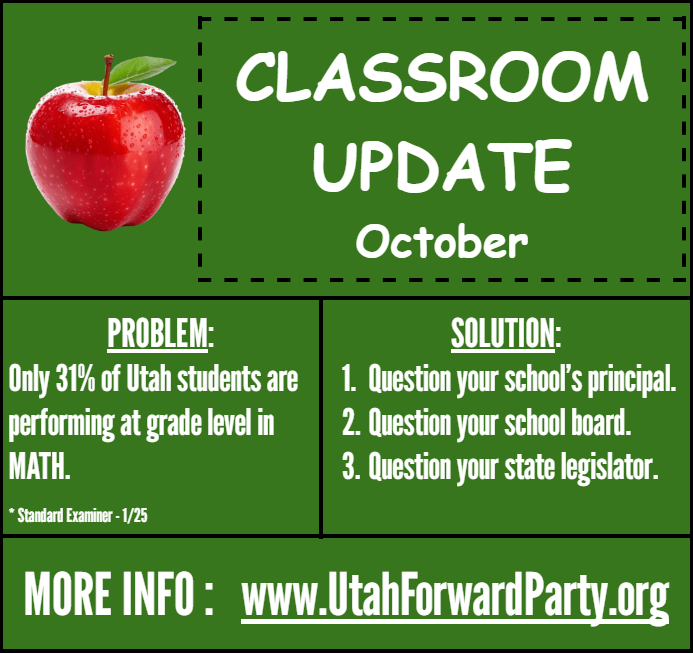
K-12 public education funding in Utah comes principally from the state income tax. As legislators lower income tax rates, the tax burden to keep the education system going tends to shift to property taxes levied by individual school districts. This can lead to greater inequality in education across the state since property values differ across communities, and it puts a bigger tax (or rent) burden on people who are on fixed incomes.
When thinking about education funding, talk to your state legislative representatives and to your local school board members about your ideas and priorities.