
The Box Elder Data Center
Ethan Adams, July 9th, 2025 (1947 words | 9 minutes)
“But data centers for AI, Palantir surveillance, Claude code bots and algorithmic social media? What’s in it for them? The Republican Party hasn’t figured out how to sell them on it yet.”
--
The Box Elder Data center, also known as the “Stratos Project” is a proposed data center on 40,000 acres in Box Elder County in a rural area called Hancel Valley, just North of the Great Salt Lake. The scale of the proposed project is massive, requiring ~9 Gigawatts of electricity, almost as much as the entire state consumes at peak summer months which was 10.3 Gigawatts in 2024.
On a hot Spring day in a municipal barn citizens threw insults and chants at three public officials as they met to approve the sale of the unzoned farmland for the project. The officials themselves complained that they had no legal basis to deny the sale, citing that the land in question was privately owned and had no zoning restrictions. The crowd, either conscious of this or not, villainized the three officials so vehemently that they stood up and unceremoniously walked out. At the time, opponents felt they had found a local chokepoint in changes that felt too distant and out of their control.

(image credit: Salt Lake Tribune)
The Proposed project has triggered one of the largest grass-roots backlash campaigns Utah has ever seen in a place most Utahns can’t locate on a map. I’ve been following how public sentiment develops on AI, specifically the infrastructure, investment capital and government cooperation it would require for a long time, but I must admit; I’ve been anxiously waiting for this convergence to come. One the the chief investors of the project, Kevil O’leary of Shark Tank fame went on Fox News to say that “The People of Utah are stupid” and accused them of being paid by the Chinese government to oppose the project and certainly put more gasoline on the fire.
I see several informative dynamics between proximate causes of opposition and direct ones. In a broad sense, I cannot think of a more class-divisive issue than AI. The whole subject reeks of an elite project being forced on Americans writ large without their consent or regulatory oversight. A project that principally benefits a handful of tech billionaires in their quest for a less expensive workforce. A world of tomorrow glazed with optimism only relevant to them. It is a project whose literal measurement of success is how many white collar workers and entry-level positions can be replaced by replicating their own labors without their consent. This has long been generally accepted by the political Right regardless, in part because of a belief that AI is a necessary evil that will make them, the privileged cutouts of the proletariat, miraculously wealthy by means yet undefined.
Techno-optimism is on full display in MAGA in every corner of the conservative media sphere, perhaps most visibly by the President's own accounts. From Elon Musk’s “mecha-Hitler” Grok chatbot, to endless AI generated Substack articles that sycophantically make the user feel profoundly intelligent simply for hitting the return key. AI generated memes, flyers and graphics turn any technologically or creatively challenged individual into a one-man marketing department for unnerving yellow-tinted images. The benefits for the old, already wealthy, and current elite are obvious…..right?

Rural conservatives have long had an uneasy relationship with big tech companies. The notion that we, the underclass in all of this, should share in the infrastructure and energy cost of a project designed to disenfranchise us further, has the potential to unite even the most dialectically opposed culture warriors. I did not expect this to be the breaking point between rural conservatives and the Republican party. Personally, I thought it would be a plethora of other things first. But AI is new; And so are its political contradictions in populist politics.
For rural conservatives ICE and tariffs would subsidize their labor value. DOGE would further cut their taxes and hurt those they don’t like or don't care about. Trump's personality would value their feelings over data and experts. Foreign wars and kinetic military drama would look cool and make you feel powerful again. Government cheerleading of conservative cultural values would make you feel important for being who you are, pity you as a man the world wrongfully left behind, and will never expect you to improve, learn, or mature, just reproduce.
But data centers for AI, Palantir surveillance, Claude code bots and algorithmic social media? What's in it for them? The Republican party hasn't figured out how to sell them on it yet.
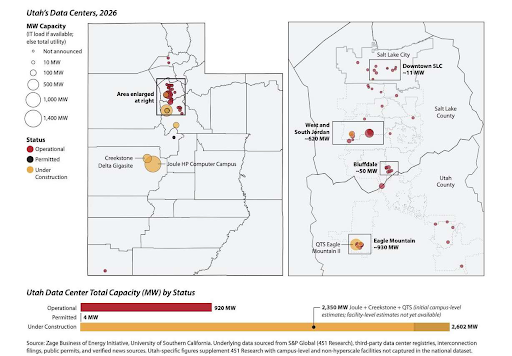
The project is being pushed forward by the Military Installation Development Authority, or MIDA which fast-tracks installations deemed to have national security interests. The US government and its elected supporters both in Utah and elsewhere. Spencer Cox has remarked on the necessity of these projects for national security. Cox has characterized this project as an integral part of his vision for Utah’s ‘energy abundance” prerogative, directly borrowing from Ezra Klein's progressive “Abundance” brand making waves across the American Left.
Kevin O’Leory speculated that the only reason why anyone would oppose this project are either “stupid people” or paid by the Chinese government to sabotage the United States. Defence officials, especially those in the Trump Administration, argue that AI development is a new arms race against China, both without any evidence. His public comments on the project both before and after the blow up has contributed greatly to its public backlash.
The administration has rolled out the red carpet for tech companies, granting them what previous Republican administrations would have staunchly opposed; A federal memorandum on any state laws regulating AI development. AI experts foresee a future in which AI is a digital superweapon. Capable of shutting down everything from infrastructure to communications from anywhere in the world. If the economic productivity increases are as foretold by techno-oracles on Twitter, AI will be a second industrial revolution that will deepen the divide between the global haves and have-nots. The government, of course, is distracted by other more aesthetically attractive or flashy prerogatives around the globe and far from congressional approval.
Ironically, China has more regulation and labor protections related to AI than the United States has, they have even formulated an entire legislative pipeline for its formation 4 years ago. The US notably does not. (https://carnegieendowment.org/research/2023/07/chinas-ai-regulations-and-how-they-get-made) Just last month a Chinese court ruled that companies were not allowed to lay off employees solely to replace them with AI.
Yes, the US is not the only ones in the game, but the development of AI supremacy without thought or care for the human fallout is neither economically or politically sustainable. I believe the Chinese and Europeans understand that. This is the first transformational technology in the modern era that did not originate in a weapons R&D project or under government control. AI is being developed almost entirely by private enterprise, and completely unregulated by the state. One key original element of the Trump Administration’s “Big Beautiful Bill” was a provision banning states from legislating AI. Ultimately this provision was dropped from the legislation to get it passed.
Additionally, government cooperation and “Moral Hazard” has combined with "bubble-like" circular investment co-reliance between most of Silicon Valley and private equity to create a fragile financial house of cards. In Q1 of 2026 AI investment alone accounted for 76% of US GDP growth. Financial observers are writing with increasing concern that AI development is a gamble so huge that if it falters it would drag the whole economy into recession. One has to wonder how much of this interest is based on actual possibilities or a fear that AI has become “too big to fail”. Governor Cox himself has been embroiled in this suspicion as well. His company CentraCom was rumored to be one of the beneficiaries of this data center, further raising suspicion on his motives and public outcry over local resistance. But these concerns have conventionally not bothered rural conservatives.
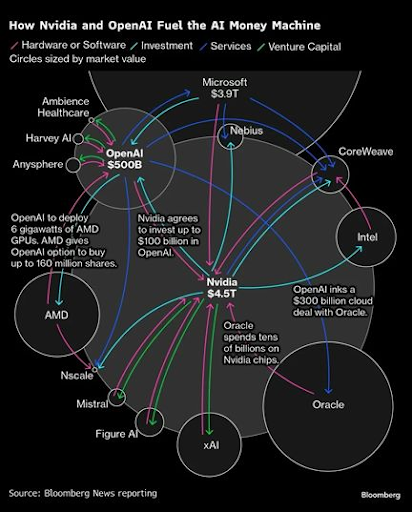
If people and corporations that count as people are paying to use these services, then they consent to these schemes, right? Yes, in a Ayn Rand type of way, if money shows up, so too does consent. But in our hybrid economic model that balances free market capitalism with government regulation deemed necessary by the voters, private finance cannot equate to permission to mobilize government attention and assistance for niche private interests. In this instance, I mean government attention in the sense that over the last five years, every article and paper I have read arguing for the rapid expansion of publicly subsidized energy infrastructure has cited predicted AI and tech demand as a leading justification for it. The government should and would fast-track energy production, build out infrastructure, rubber-stamp permitting, and overall would contort public utilities and infrastructure specifically for these projects. The "government should build it, so we can arrive" model of economic development cannot merely benefit the tech elites through billions in government assistance.
Environmental concerns are of course expected. The facility would be so large and consume so much power that it would significantly alter the local climate. The average temperature of the surrounding area would increase as much as 12 degrees fahrenheit. The project promises to use a “closed-loop water cooling system”. Projections for how much water the facility would use is highly disputed, but on the low end it would consume that of a large office complex. However, to power it with some combination of nuclear, coal, and natural gas would require enormous amounts of water. Again, Utah conservatives are rarely concerned with environmental impacts.
I understand water concerns to be a proximate cause for opposition. Like immigration, it's a symptom of opposition unstated elsewhere rather than one directly stated plainly. Water usage is a hot topic in general because it's being squeezed between three principle groups; Rural Utahns that want to maintain their hobby farms, Wasatch environmentalists concerned about the lakes and streams, and rapidly expanding urban developments chasing Utah's population demands. Data centers are a new headline that most people aren't familiar with and don't see the value in. If you build a new Costco nearby, you get cheap rotisserie chicken and 10 pounds of Gold Fish. A data center can be in your backyard or the bottom of the Atlantic ocean, it makes no difference to the end user. Completed and proposed data centers in Canada, The UAE, Saudi Arabia, and scattered across Texas and Virginia consume large fractions of their state’s total energy production. In Virginia data centers account for 25% of the state's total consumption, Texas 10%, and California 3.7%.
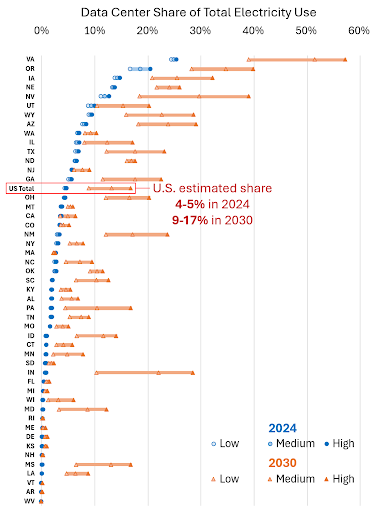
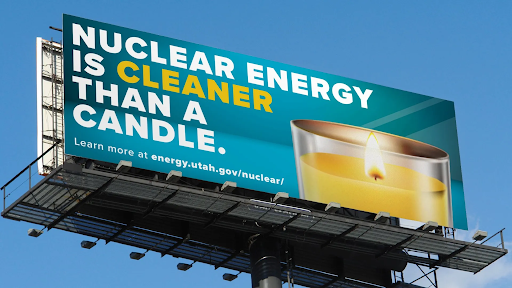
People closest to this issue geographically aren't going to be the primary beneficiaries. Rural Utahns in Boxelder County will use these data centers far less than Claud developers, supply chain managers and investment bankers will use them to reduce workforce costs. In their minds, the typical urban corpo-elite that flies over them every day. Ironically, whether consciously or not, the coalition against the data center represents a unique class consciousness, however fragile, that has yet to endure more robust lobbying campaigns and PR damage control from those in power. Billboards supporting nuclear power and I expect marketing promoting jobs or….. something for the average Utahn.
For now, Governor Cox has toned down his bullish tone regarding the project, promising more transparency, slower timeline, and more research regarding its impact. What is still missing is a coherent plan for how such an ambitious project would even be powered and what resources it would even require. The strategy seems to be to build it first so the state is then obligated to figure out the rest for them. Alternatively, the bubble will pop, the money will disappear, and the state and its tax payers will be left holding the bag.
--
Ethan Adams is a resident of Salem, Utah, and a member of the Forward Party.
--